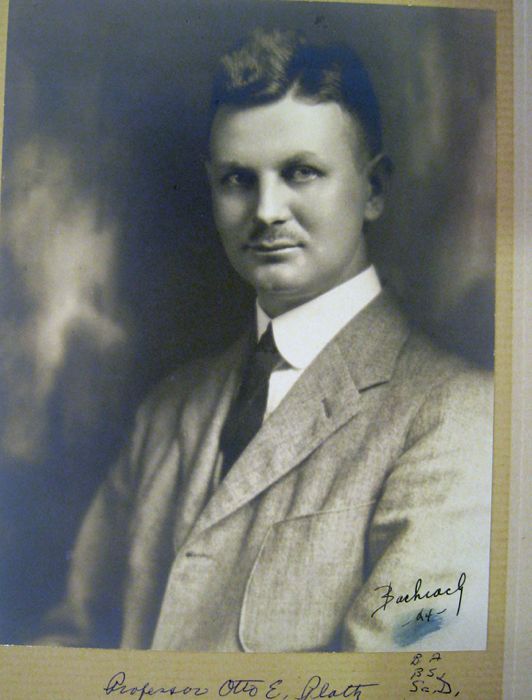
Plath, Otto Plath

The following is a post first started between June and December 2012, revisited briefly in June 2014, and then forgotten about as I was working full time on the letters of Sylvia Plath project. I felt it was important to work on the blog some more this fall with the intention of posting it on 5 November, which was the 75th anniversary of the death of Otto Plath. But then other things got in the way...

Recently, though, I had a change of heart about the bulk of this post. Much of what I wanted to say I learned years ago but will refrain from posting now as I believe that Heather Clark, in her forthcoming biography of Sylvia Plath, will discuss at beautiful and thorough length the history and biography of Otto Plath.

However, what I do still want to relate is interesting information I obtained Warren's Plath's daughter Susan in June 2014 concerning something Paul Alexander wrote as fact in his biography of Sylvia Plath, Rough Magic. Alexander writes, "On April 13, 1885, in the village of Grabow, Germany, he a born Otto Emil Platt" (Da Capo Press edition, 2003: 15). This is patently not true. Susan told me that when she asked Alexander about this several years ago he admitted that he simply made it up. (And makes me wonder what else he made up in his book! Rough Magic, indeed ) So, if you ever happen to read anywhere that Otto Plath was born Platt, please keep in mind this valuable information provided by the PLATH family.

Popular posts from this blog

Famous Quotes of Sylvia Plath

Sylvia Plath inspires us all in various and wonderful ways. She is in many respects a form of comfort to us, which is something that Esther Greenwood expresses in The Bell Jar , about a bath: "There must be quite a few things a hot bath won't cure, but I don't know many of them. Whenever I'm sad I'm going to die, or so nervous I can't sleep, or in love with somebody I won't be seeing for a week, I slump down just so far and then I say: 'I'll go take a hot bath.'" We read and remember Sylvia Plath for many reasons, many of them deeply personal and private. But we commemorate her, too, in very public ways, as Anna of the long-standing Tumblr Loving Sylvia Plath , has been tracking, in the form of tattoos. (Anna's on Instagram with it too, as SylviaPlathInk .) The above bath quote is among Sylvia Plath's most famous. It often appears here and there and it is stripped of its context. But I think most people will know it is from her nove...

Some final photographs of Sylvia Plath

Susan O'Neill-Roe took a series of photographs of Sylvia Plath and her children from October to late November (or maybe early December) 1962 while she was a day nanny/mother's help at Court Green. From nearby Belstone , it was a short drive to North Tawton and the aid she provided enabled Plath to complete the masterful October and November poems and also to make day or overnight trips to London for poetry business and other business.  Some of O'Neill-Roe's photographs are well-known.  However, a cache of photographs formed a part of the papers of failed biographer Harriet Rosenstein. They were sold separately from the rest of her papers that went to Emory. I was fortunate enough to see low resolution scans of them a while back so please note these are being posted today as mere reference quality images.  There are two series here. The first of the children with Plath dressed in red and black. (This should be referred to in the future, please, as Plath's  Stendhal-c...

Amy C. Rea Reviews Heather Clark's Red Comet: The Short Life and Blazing Art of Sylvia Plath

Here’s a thing about me: I’m a voracious reader, but very rarely have a physically based emotional response to something I’m reading. I don’t laugh out loud, I don’t cry, both of which I do when watching movies. It’s not that I don’t find things funny or sad when I read, but apparently I need more of a visual cue. So it’s telling that when I got to the end of Dr. Heather Clark’s new biography of Sylvia Plath, Red Comet , I cried. It’s not as if I didn’t know how the story ended. But the level of detail and analysis Clark brings to her study of Plath is so detailed, and her examination of those brutal last weeks so deeply explored, that it broke my heart. Clark has done some tremendously important and much-needed work with this biography. It would be remiss of me not to note the aid she received from Peter K. Steinberg and the work he did compiling Plath’s Letters . Clark clearly spent a great deal of time studying these source materials, as well as others that were not available ...