
Sylvia Plath's "Snow Blitz" is one of the last three prose pieces we know she completed. The other two are "America! America!" (typescript title "The All-Round Image", circa 20-22 January 1963) for Punch and "Landscape of Childhood" (a.k.a. "Ocean 1212-W") for the BBC (circa 28 January 1963). All three exhibit a certain degree of creative, or imaginative writing; however, overall in tone, length, and narrative style, they are indisputably non-fiction.
"Snow Blitz" spans about a month of time, starting on Boxing Day, 26 December 1962 ("In London, the day after Christmas (Boxing Day), it began to snow...") and ending just about one month later on 26 January 1963 ("Then, just a month after the first snowfall, the weather relaxed.").
If the chronology is true, then it was likely written around the same time at "Landscape of Childhood" though in the absence of evidence--say, the missing journals--it is impossible to know in what order they were composed. Plath's last submissions list, begun on 9 November 1962, tracks her poetry efforts exclusively. When it was first published in Johnny Panic and the Bible of Dreams (1977) it was classed, rightly, as an "Essay". However, the original typescript, housed at Smith College, is stored with her short stories.
With having written "America! America!" and "Landscape of Childhood" on commission, it seems likely to me that Plath was trying her hand at more journalism. "Snow Blitz" has a sort of voice of the "here-and-now" of London; it is a factual, point-of-view piece with her own unique humor mixed in for good measure. (She may have been trying to get pieces published in London periodicals similar to the many poems and prose works she placed in the Boston-based Christian Science Monitor in the 1950s.)
Reading "Snow Blitz" recently (ha ha--this blog post was drafted in March 2019!), I thought I would look into some of the details she recorded in the piece. I was happy to find some corroboration. Though, to be honest it made me somewhat sad for the environment she was in and the circumstances of her life at the time.
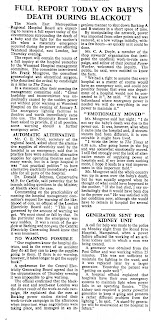
While it did begin to snow in December and the weather turned cold too, the "Big Freeze" and its side effects seems to have officially started around 3 or 4 January. Electrical worker strikes commenced on 3 January 1963 due to the "work-to-rule" campaign and overtime ban. A baby did die on 3 January 1963 during a power cut. The power cuts were still in effect on the 10th and the 14th. There was a big blackout on the 18th. On several days, from the 17th of January to the 2nd of February, The Times published Letters to the Editor under the title of "Not Enough Power".
Here is an article from the 9 January 1963 issue of The Times on the death of a baby:
Here is one of the "Letters" from 17 January 1963 on "Not Enough Power", also from The Times:

The "Big Freeze" and electrical blackouts coincided with Plath and her children all coming down with a bad colds and flu. Clarissa and Paul Roche visited in early January, too. Due to their being no calendar or journals for the period, and scant letters, there is a general lack of information for this period on how exactly Plath coped for the duration of the bad weather. However, we know that during this time she still managed to get out to the BBC on the evening of 10 January 1963 to record her review of Donald Hall's Contemporary American Poetry anthology. In that broadcast, released for the first time in 2010 on The Spoken Word: Sylvia Plath, her voice certainly sounds stuffy and affected by her cold. She had a live-in nurse during this period too, and was actively shopping for an au pair, who was installed around the middle of the month. She got out, too, to see at least one film and likely more. However, it was the presence of the au pair in late January that was a key factor in her creative productivity in poetry and prose at the end of the month and into early February.
"Snow Blitz" spans about a month of time, starting on Boxing Day, 26 December 1962 ("In London, the day after Christmas (Boxing Day), it began to snow...") and ending just about one month later on 26 January 1963 ("Then, just a month after the first snowfall, the weather relaxed.").
If the chronology is true, then it was likely written around the same time at "Landscape of Childhood" though in the absence of evidence--say, the missing journals--it is impossible to know in what order they were composed. Plath's last submissions list, begun on 9 November 1962, tracks her poetry efforts exclusively. When it was first published in Johnny Panic and the Bible of Dreams (1977) it was classed, rightly, as an "Essay". However, the original typescript, housed at Smith College, is stored with her short stories.
With having written "America! America!" and "Landscape of Childhood" on commission, it seems likely to me that Plath was trying her hand at more journalism. "Snow Blitz" has a sort of voice of the "here-and-now" of London; it is a factual, point-of-view piece with her own unique humor mixed in for good measure. (She may have been trying to get pieces published in London periodicals similar to the many poems and prose works she placed in the Boston-based Christian Science Monitor in the 1950s.)
Reading "Snow Blitz" recently (ha ha--this blog post was drafted in March 2019!), I thought I would look into some of the details she recorded in the piece. I was happy to find some corroboration. Though, to be honest it made me somewhat sad for the environment she was in and the circumstances of her life at the time.
While it did begin to snow in December and the weather turned cold too, the "Big Freeze" and its side effects seems to have officially started around 3 or 4 January. Electrical worker strikes commenced on 3 January 1963 due to the "work-to-rule" campaign and overtime ban. A baby did die on 3 January 1963 during a power cut. The power cuts were still in effect on the 10th and the 14th. There was a big blackout on the 18th. On several days, from the 17th of January to the 2nd of February, The Times published Letters to the Editor under the title of "Not Enough Power".
Here is an article from the 9 January 1963 issue of The Times on the death of a baby:

Here is one of the "Letters" from 17 January 1963 on "Not Enough Power", also from The Times:

The "Big Freeze" and electrical blackouts coincided with Plath and her children all coming down with a bad colds and flu. Clarissa and Paul Roche visited in early January, too. Due to their being no calendar or journals for the period, and scant letters, there is a general lack of information for this period on how exactly Plath coped for the duration of the bad weather. However, we know that during this time she still managed to get out to the BBC on the evening of 10 January 1963 to record her review of Donald Hall's Contemporary American Poetry anthology. In that broadcast, released for the first time in 2010 on The Spoken Word: Sylvia Plath, her voice certainly sounds stuffy and affected by her cold. She had a live-in nurse during this period too, and was actively shopping for an au pair, who was installed around the middle of the month. She got out, too, to see at least one film and likely more. However, it was the presence of the au pair in late January that was a key factor in her creative productivity in poetry and prose at the end of the month and into early February.
Maybe it is a good thing I delayed this post for so long because I can recommend Heather Clark's Plath biography Red Comet for more information.
If you benefited from this post or any content on the Sylvia Plath Info Blog, my website for Sylvia Plath (A celebration, this is), and @sylviaplathinfo on Twitter, then please consider sending me a tip via PayPal. Thank you for at least considering! All funds will be put towards my Sylvia Plath research.